

Exit Hawkins - Putting the Task Force into Softly Softly
First part exploring how the long running police series Softly Softly moved three of its senior cast members from black and white west country and into colourful Thamesford.

In 1969, BBC1 was moving into colour for those viewers who would be able to experience it. Several drama series which would have to transform midway through their run, giving them a good excuse for a revamp. Dixon of Dock Green went into colour along with much of BBC1 on 15 November 1969, while Z Cars would take their time and change during February 1970. But for Barlow and Watt - who left the grim world of Newtown and headed south at the end of 1965 for the spin off series Softly Softly, will relocate once again into a new all colour series which would be set on the other side of the country.
The narrative change wouldn’t occur overnight. The producers and its chief writer Elwyn Jones took for their template how the transition from Z Cars into Softly Softly was handled. That time, Barlow and Watt were followed by Robert Keegan’s retired desk sergeant ‘Blackie’ who was then employed by Crime Squad as a civilian at the end of the second episode.1 This time Barlow and Watt will be joined by Sergeant Hawkins, played by Norman Bowler, who will gain promotion and become the first to move east weeks ahead of his superiors. Bowler had been with the series since its first episode in 1966, the only regular to survive all five series without any fear of sudden transfer, dismissal or suffering from depression during a wistful Alan Plater script.2 Unlike Keegan who left after two series, Bowler will see the new series out.
The plan was for Softly Softly to wind up after ten episodes, with Barlow departing Wyvern at the end of the ninth episode, leaving Watt alone and pondering his future in the finale firm in the knowledge he would not be offered Barlow’s job and should an offer from Thamesford as consolation be on the cards... This would be followed immediately by seventeen colour episodes of Elwyn Jones’ new format Task Force starting with Barlow as the new head of CID terrorising the head quarters of his new sloppy police force (who appear to be guarded by a simple yale lock) before investigating a missing child. Harry Hawkins was also to be seen in charge of a station and in full Detective Inspector uniform, criticising egg stains on the ties of a professional, yet endearing, Welshman. Watt would follow down in the second episode for an amusing reunion just as he did in 1966, giving his chief a chance to settle in and establish relationships with the new regulars.3
So let us return to Softly Softly series five. Barlow and Watts are being supervised by John Barron’s deputy-chief constable. Other than Hawkins, under them was a fluid team who at the moment were Police Woman Detective Sergeant Barbara Allin who joined the programme from the beginning of its third series, Detective Inspector Jim Cook played by Philip Brack and Gavin Campbell as Detective Constable William Digby, both of whom had been introduced in this episode from January 1968…
The first episode4 to indicate change was in the air was ‘General Post’ written by none other than Elwyn Jones, who usually bagged the significant instalments, and was commissioned for batches of episodes at a time. This episode was shown on Thursday 23 October 1969, just under a month after its recording in TC6 on Thursday 25 September. Directed by Vere Lorrimer, it was rehearsed at the Rugby Boys’ club after a week’s filming from 8 to 12 September in London and for one day only, the west country.
The main thrust of the plot is the violent robbery and hijack of a post office van and the brutal assault on its driver, who much to their surprise, runs into the nearby Crime Squad office to report it. The team are disgusted that a crime takes place right under their noses. The thief then goes into a post office and follows correct procedure and procures three mail bags. He signs the correct forms as Harry Snow.5 The detectives suspect the assailant is either a serving or an ex-post man. But the crime plot is being played out against the beginnings of the end of the Wyvern Crime Squad in its current form and this is the part of the plot I want to focus on.
The episode begins with Hawkins laboriously typing out a letter applying for promotion to the Chief Constable of Thamesford Constabulary. He has kept this quiet from his colleagues, although Allin quickly guesses because of Hawkins’ secretive behaviour. Hawkins asks Gilbert to vet his letter and he isn’t pleased not to have been consulted. Neither have Barlow or Watts: ‘And I thought ours was a happy ship.’ He is displeased by the letter and points out many errors in presentation and grammar. In his own inimitable way, Gilbert offers to guide the style of the letter and tells Hawkins to get his secretary to type it out.
When Gilbert informs them, Watt is about as sympathetic and understanding as he can be with Hawkins’ secretive behaviour but Barlow is furious: ‘It’s a bloody insult!’ Harry’s promotion would make him a ‘uniformed inspector’. Watt admits he is disappointed he wasn’t consulted. Perhaps he felt he couldn’t, Gilbert observes, citing man management issue…
We learn the background: a new Chief Constable has been installed at Thamesford, a poorly performing constabulary which Watt sums up as ‘under-manned, under-equipped and crawling with traffic wardens.’ Barlow agrees it needs all the best men it can get.
In a later scene, Watt is discussing Hawkins promotion efforts with Cook, and they both suspect Barlow is also up to something. Cook is pleased - let them both go and Watt will be promoted. But Watt is not pleased: ‘You’re daft. Without Charlie Barlow this whole Regional Crime Squad is a political joke…. Mr Gilbert sits up there, very smooth, very suave, and more teachable than I thought he’d be. Giving us more support than I thought he would. But he’s not about crime, Jim. He’s about order, and law enforcement, and traffic even… public relations and crime prevention… Charlie Barlow’s about crime, against it… And so am I.’ But always in his shadow, Cook suggests? That sinks in.
Watt jibes Hawkins over his behaviour when his subordinate comes in with names of three ex-posties who have either recently been discharged or made redundant. Gilbert tells Hawkins that since he prefers to leave, he would like him to succeed and this case is his chance ‘to report only on your actual initiative and performance.’ Watt is a bit rough on Hawkins when he sends him out on routine enquiries to question every post man in the district: ‘our best wishes go with you on this heart-rending quest.’
Then Gilbert sees Barlow and reveals he knows Hawkins will get the job. Gilbert has been in touch with the new Chief of Thamesford Constabulary, the growling and menacing Arthur Cullen yet to be seen. Gilbert remarks to a startled Barlow ‘So you enjoyed your lunch.’ Barlow is suddenly on the back foot now that his own secretive behaviour has been exposed. Gilbert may be no policeman but he is a politician with excellent sources. Barlow hasn’t decided yet whether to apply to join Thamesford. Gilbert warns Barlow not to be over-confident that promotion is actually his choice… Had he been a newly appointed Chief Constable of a run down force, seeking a new head of CID, Gilbert may have opted for a younger man who would feel indebted to him, which was the type of promotion Barlow received when he came here (under a different boss). Then he brings in John Watt’s name - would the same job be too big a jump for him? Barlow won’t say a word against his colleague but observes Watt would do his own job here at Wyvern very well…
So there we have it. Barlow too wants to move on and sees Thamesford as his route to promotion but is also aware he has to handle the situation carefully. Scenes between Barlow and John Barron’s Gilbert are always a joy to watch, each trying to outmanoeuvre or manipulate the other. They first encountered each other in a rare three part story which ran over the Christmas and New Year period of 1966/1967 and was considered a great success. Theirs had not been a happy encounter as you will shortly see. And when Gilbert became his superior a few months later, it took some time for a rapport to become established - and typically those particular scripts have been misfiled at Caversham.
After investigating the likely rogue post man with Watt, Barlow has a ‘corny hunch’. Could Harry Snow’s initials be the same as one of the former or current posties and discovers there is indeed a match - Harry Sugden who has already been routinely interviewed and was on his day off when the van was stolen. However, a partial thumb print matches his. The conversation soon returns to the vacant post of the Head of CID at Thamesford. Watt reveals that he wants to apply. Barlow says very quietly: ‘I wouldn’t John. Too much competition.’
Barlow and Watt don’t arrest Sugden immediately, simply giving the terrified man warning that they will charge him ‘at the proper place and time’ for theft. They get him to confess he is working with a gang who will use the van in order to rob security guards of a cash box. He tells them where to find the van so they can set up a trap.
Gilbert is appalled that the Crime Squad are going to provoke a future crime but Watt says the crime is already planned: they are not provoking it. Gilbert relents and an interception is prepared.
The gang is caught in the act. Barlow and Watt are in charge, much to Hawkins’ resentment because he is younger and stronger, and they could get hurt, and he genuinely believes this, rather than losing out on a vital collar. But the returning heroes tell Hawkins to get down to Wesley Road station and make sure the prisoners’ statements make sense and prepare the case. ‘We want you to go out in a blaze of glory.’ says Watt. It is also to prevent Sugden’s lawyer claiming he received undue pressure to cooperate from Barlow and Watts. Then Barlow congratulates him - the ‘promulgation just come through. This is your last case with us.’ Watt shakes him by the hand: ‘We lose a sergeant. Thamesford gains an inspector.’ Allin gives him a kiss. Barlow stops things from getting too sentimental and leaves. Hawkins also goes. ‘He leaves the office. For ever.’6
The Reading Evening News described the episode as ‘top rate’ while Miss M Ginell from Birmingham writing in the Daily Post may have been upset by what she witnessed: she told the paper how much he looks like Tom Jones.
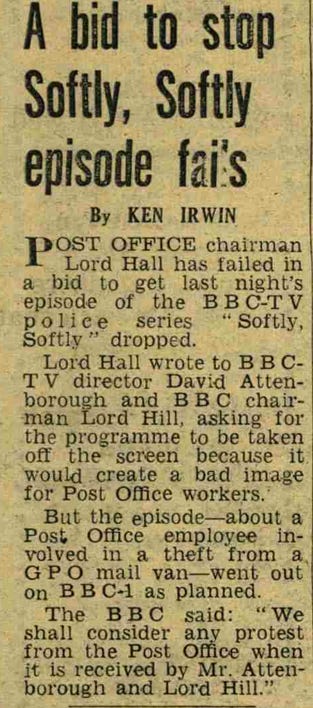
An organisation not impressed by the episode was the Post Office as this clipping from the Daily Mirror the morning after reveals.
COMING SOON: Douglas Camfield’s first attempt at a children’s half hour drama script was called ‘Adventure to Order’ and featured a young Michele Dotrice. We take a deep dive into this charming fantasy of a lonely boy on holiday in Cornwall.
COMING SOON: Did someone Call for Kuprin, an existing two part play from 1961 based on the novel by MP Maurice Edelman and adapted by Anthony Steven. The story features an unofficial attempt to stop the Soviets from one day arming their Sputniks with missiles. Only one Soviet scientist has the ability do that, an Anglophile named Kuprin, and he has many friends in England who could persuade him to defect… If they have read their man right.
COMING SOON: ‘We Shall Miss You’. When Barlow met Cullen for the first time but in black and white…
No attempt has been made to infringe upon the copyright of the estate of Elwyn Jones.
Saturday Morning Press sponsors the Softly Softly and Z Cars of its day:

Keegan grew bored with his part and left after the second series much to the disappointment of the production team and their superiors who were also concerned how the news of Keegan’s departure would be reported by the press. Shaun Sutton was keen to retain the actor for the BBC and was able to place Keegan in a regular role on the new Alan Plater series The First Lady.
This was the fate of Detective Constable Ben Box played by Dan Meaden, a gentle giant, who during the fourth series was heading for a breakdown and was written out in an Alan Plater script.
The plan had been that after the first few Task Force episodes had been transmitted and the new format bedded in, to drop the Softly Softly prefix, but it was quickly decided to keep the valuable and respected branding.
Although I haven’t read the script, there may have been allusions to Hawkins’ desire for promotion in the previous episode ‘One Thing Leads to Another’ since this was the last time he would work with Digby who was absent this week.
Henry Snow, the future dog handler in various Softly Softly Task Force had been christened some months before in several format documents.
The camera directions suggests that Hawkins is left alone in the office and then receives a big close up.